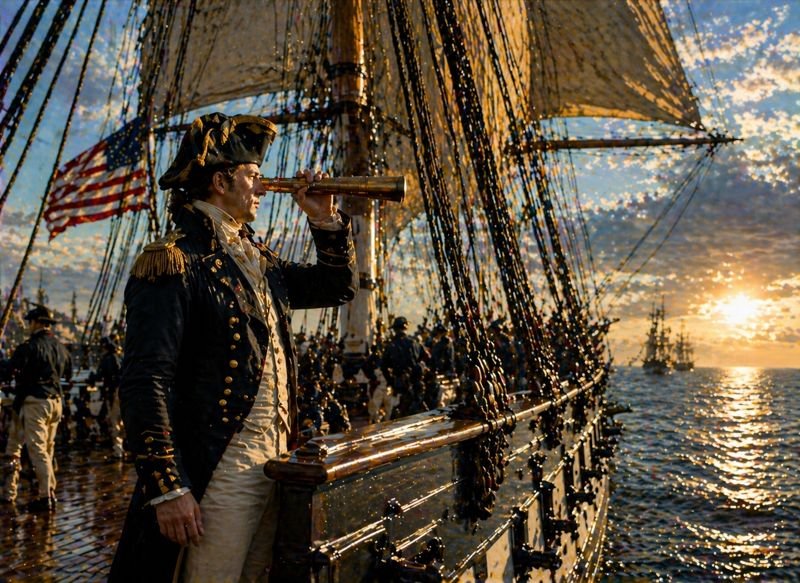
The USS Constitution was one of the most advanced and formidable warships of its time, and its specifications set it apart from almost every other frigate in the late 18th and early 19th centuries. Designed by Joshua Humphreys, the ship reflected a deliberate strategy: to build vessels that could outfight anything they could not outrun and outrun anything they could not outfight.
In terms of size, USS Constitution was significantly larger than a typical frigate of the era. She measured approximately 175 feet in length (gun deck), with an overall length of around 204 feet including bowsprit. Her beam (width) was about 43.5 feet, and she displaced roughly 2,200 tons when fully loaded. This made her heavier and more robust than most European frigates, which were generally smaller and lighter.
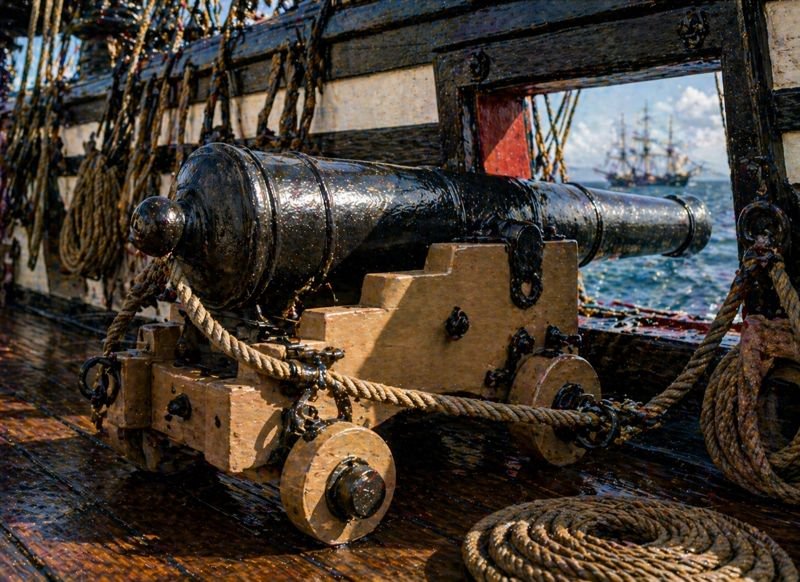
Her armament was another defining feature. Although officially rated as a 44-gun frigate, the USS Constitution often carried more, typically around 50 to 55 guns in practice. Her main battery consisted of 24-pounder long guns on the gun deck, which were heavier and more powerful than the 18-pounders commonly used on British and French frigates. On her upper deck, she carried carronades; shorter, large-caliber guns designed for devastating close-range firepower. This combination gave her a powerful broadside capable of overwhelming most opponents of a similar class.
The construction of USS Constitution was equally important in distinguishing her from other ships. She was built using dense Southern live oak, a wood known for its exceptional strength and resistance to damage. Her hull sides were unusually thick, up to 21 inches in some areas, making her remarkably durable. This strength led to her famous nickname, “Old Ironsides,” after cannonballs were seen bouncing off her hull during combat.
Another innovative feature was her internal structure. Humphreys incorporated diagonal riders (large internal braces) that reinforced the hull and reduced flexing in heavy seas. This helped maintain the ship’s structural integrity over time and improved her performance under stress. Combined with her longer hull design, this gave USS Constitution both speed and stability, allowing her to sail faster than many heavier ships while remaining strong enough to endure battle.
When compared to other ships of the time, USS Constitution occupied a unique position. Traditional frigates were designed primarily for speed and scouting, often avoiding direct engagement with larger ships. Ships of the line, on the other hand, were heavily armed but slower and less maneuverable. USS Constitution effectively bridged this gap. She had the speed of a frigate but the firepower and durability approaching that of a much larger warship.
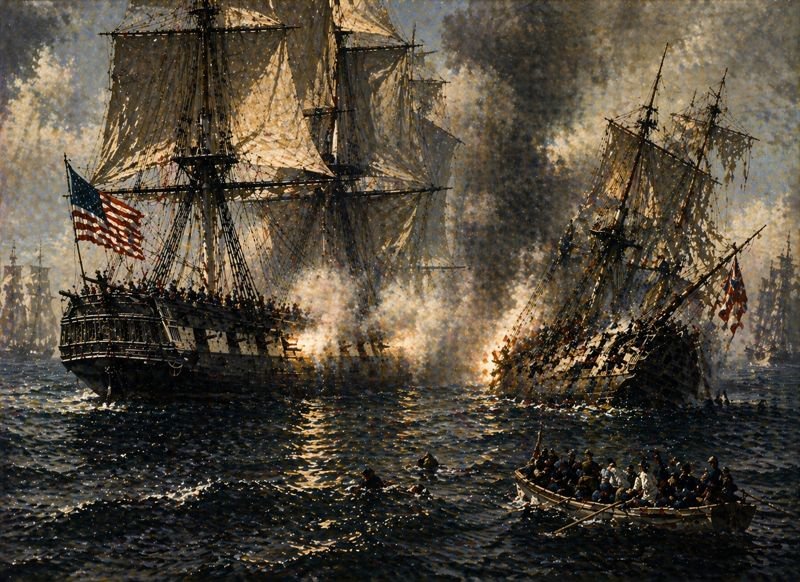
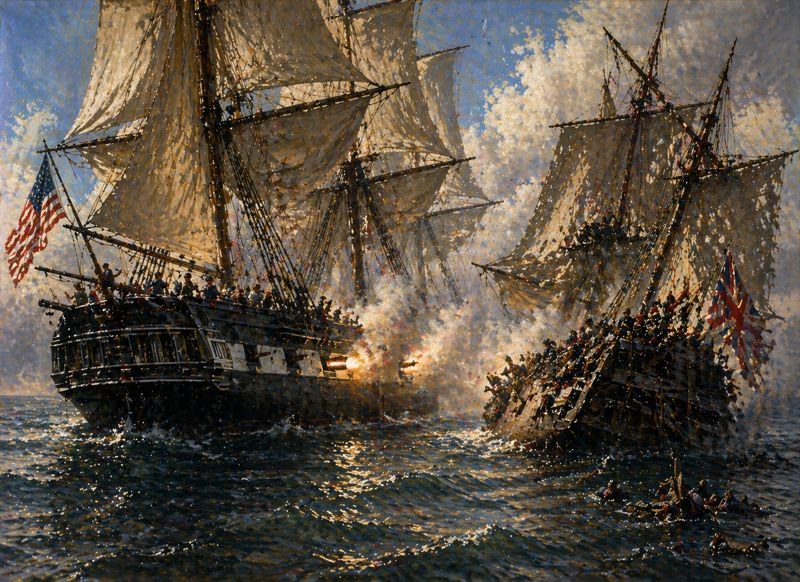
This design philosophy proved highly effective in practice. During the War of 1812, USS Constitution achieved several notable victories against British frigates, including HMS Guerriere and HMS Java. In these engagements, her heavier guns and stronger construction allowed her to inflict significant damage while sustaining relatively little herself. Her ability to dominate other frigates while avoiding ships of the line demonstrated the success of Humphreys’ design.
Another key difference was her endurance. USS Constitution could carry more supplies and remain at sea longer than many comparable vessels. This made her well suited for extended missions, such as protecting American merchant shipping or engaging in distant conflicts. Her larger size allowed for greater storage capacity without sacrificing performance.
In a broader sense, USS Constitution represented a shift in naval thinking. Rather than attempting to match the massive fleets of European powers, the United States invested in a smaller number of highly capable ships. These vessels were designed to maximize effectiveness and flexibility, allowing them to operate independently and achieve strategic advantages without requiring large-scale fleet support.
The specifications of USS Constitution, her size, displacement, armament, and construction, made her one of the most formidable frigates of her era. She was faster, stronger, and